Wednesday, February 5, 2014

Milk Thistle (Silybum marianum)

Milk Thistle
1. History

Milk thistle has been used for medicinal purposes for thousands of years. Scientists and physicians from the Roman Empire used it to treat snake bites; later British herbalists proposed uses for liver, spleen, and blood disorders.

2. Medicinal and Non-Medicinal use

The most common diseases and conditions that milk thistle is currently claimed to have use in treating are diabetes mellitus type 2, diabetic nephropathy, liver cirrhosis, and chronic liver disease. For diabetes, milk thistle has been shown to have hypoglycemic properties. For liver disorders, milk thistle is thought to act on hepatocytes to decrease oxidative damage from and increase clearance of toxins and other substances.

Non-medicinal uses include previous use as food. Milk thistle is related to the artichoke and is technically edible, but people don’t commonly eat it any more.

3. Major component(s) hypothesized to be the active ingredient(s). Include chemical entities if applicable

Milk thistle is used medicinally as an extract taken from the seeds, called silymarin. The silymarin extract contains several flavonoid compounds thought to be pharmacologically active, with the most active being silibinin (also called silybin).

4. Theorized Mechanism of Action

It is thought that milk thistle prevents oxidation in the liver and increased hepatocyte protein synthesis. Theories also suggest that it competes with hepatocytes for toxin binding/degradation, explaining its use in chronic liver diseases

5. Clinical Issues

a. DDIs
Milk thistle has been shown in vitro and in vivo to inhibit CYP2D6, CYP2C9, and CYP3A4, resulting in increased concentrations of drugs that are metabolized by these enzymes. There is some evidence that milk thistle may also inhibit the p-glycoprotein efflux pump.

b. Suggested Dose
Silymarin extract is standardized to contain 70% to 80% of the active drug components. The most commonly studied and suggested doses are 140 mg to 250 mg three times a day. Due to uncertain standardization of products, anyone taking milk thistle supplements should follow the package directions specific to a certain brand of product.

c. Adverse effects
The most common effects are mild GI distrubances and linked to usage at a higher than recomended dose. People with known allergies or hypersensitivities to asters, daisies, artichokes, or kiwi are more likely to be allergic to milk thistle, for which anaphylaxis reactions are rare but have been reported. Some reports, especially of alcoholic cirrhosis treatment, yielded an allergic response manifesting as pruritus and urticaria. 

d. Pharmacokinetics
Bioavailability: 23-47%
Half life: 0.7-1.4 hours
Peak plasma levels at 1.5 hours after oral administration

e. Overdose
Milk thistle overdose is unlikely. There is low toxicity when taken in typical doses, but when increased well beyond therapeutic indications, a laxative effect was seen. One study done on healthy volunteers showed no toxicities after a three week course of over 1000 mg per day..

f. Use in special populations:

i. Pregnancy

Milk thistle is thought to be in pregnancy for minor liver insufficiencies if use is limited to three weeks. Product is well tolerated by patients, but there have been no studies done with systemic data. More research is needed in this area.

ii. Lactation
Milk thistle has been long thought to increase milk production. One study showed that 420 mg of milk thistle (as micronized silymarin) given for 63 days to lactating women increased their milk production compared to placebo (85% vs. 32%). Although more research is probably needed, milk thistle is thought to be safe for breastfeeding infants due to poor oral absorption from the GI tract.

iii. Elderly
Special consideration of other drugs or supplements should be made considering evidence of hepatotoxicity with a 69-y.o. woman who used a combination product that included horse chestnut, milfoil, celadine, sweet clover, and dandelion root. However, upon discontinuation of the supplement, her liver function reverted back to normal.

6. Efficacy vs. Safety

For most people, milk thistle is generally considered to be safe and unlikely to produce toxicity at typical doses, although is not on the GRAS list from the FDA. It may not be safe for diabetics taking hypoglycemic drugs due to additive hypoglycemic effects. Caution is also needed in patients taking drugs metabolized by CYP3A4, CYP2C9, or CYP2D6, due to inhibition of their metabolism by milk thistle. Animal research suggests that agents needing glucuronidation for clearance may have decreased metabolism/clearance from milk thistle use.

7. Information about the standard of the various preparations available

Often packaged with other “liver detoxifying” agents like dandelion and turmeric. Single product, with few other ingredients and with many other ingredients for different blends/health uses. All had the standard 80% and most used both plant extract and seed parts.

8. Cost (compare to prescription medicine)

100 capsules of the standardized 80% silymarin extract:
70 mg - $17
175 mg - $23
 300mg - $27

See section 11 on comparable prescription medicines.

9. Prevalence of Use

Milk thistle is not one of the Top 10 Natural Products in the US, according to the National Center for Complementary and Alternative Medicine (NCCAM), which collects data about the most used CAM products.

10. Evidence-Based Medicine

The Natural Standard evidence-based grading system rates the quality of the evidence from studies on the use of milk thistle in various diseases and conditions. For liver cirrhosis, chronic liver disease, diabetes mellitus type 2, and diabetic nephropathy, milk thistle treatment was rated at Level B, meaning that benefit was shown to be statistically significant in 1 or 2 properly randomized trials.

A) Liver Cirrhosis

i) Double-blind RCT investigated silymarin (dosed 150 mg TID for 2 years) compared to placebo. Study failed to show increased survival rates in the silymarin group [Ferenci 1989].

ii) Double-blind RCT investigated silymarin (dosed 420 mg per day for an average of 3.4 years) compared to placebo. Study showed improved survival among patients with mild cirrhosis in the silymarin group  [Pares 1998].

B) Chronic Liver Disease

i) Double-blind RCT investigated silymarin (dosed 420 mg TID or 700 mg TID for 6 months) compared to placebo. Study failed to show improvements in liver function, measured as changes in serum ALT levels [Fried 2012].

ii) Double-blind RCT investigated silymarin (dosed 420 mg per day for 6 months) compared to placebo. Results showed improvements in liver function, measured as changes in serum ALT, AST, and bilirubin [Feher 1989].

C) Diabetes Mellitus Type 2

i) Double-blind RCT investigated silymarin (dosed at 200 mg daily for 4 months) as adjunct to treatment with a sulfonylurea compared to sulfonylurea plus placebo. Results showed improved fasting blood glucose, post-prandial blood glucose, A1C, and weight management [Hussain 2007].

D) Diabetic Nephropathy

i) Double-blind RCT investigated silymarin (dosed 140 mg three times daily for 3 months) compared to placebo. Results showed improvement in diabetic nephropathy, measured with the surrogate of urinary albumin to creatinine ratio [Fallahzadeh 2012].

11. Comparable prescription or non-prescription medicines

Micronase (glyburide) - hypoglycemic for DM2
Generic - $4 per month

Januvia (sitagliptin) - hypoglycemic for DM2
Brand - over $300 per month

Epivir (lamivudine) - treatment of chronic viral hepatitis B
Generic - $100 to $200 per month
Brand - $450 per month

Baraclude (entacavir) - treatment of chronic viral hepatitis B
Brand only - over $1000 per month

12. Discussion of milk thistle with...

a. "Health store" employee

i. Find out the claims of what this product could be used for:

Any liver dysfunction or hepatitis that would require more help with detoxification or purification of the body. The milk thistle products were located in the "detox" section.

ii. Safety issues and knowledge level for the employee about this product

The more severe of condition, she recommended a higher dose product. The highest dose product was 300 mg capsules taken three times daily. No safety concerns were addressed other than instructions to follow package label directions. General employee was not that knowledgeable about the product, but asked her manager, who seemed to know things off the top her head. 

b. Pharmacist

i. Find out their knowledge level about the clinical issues as it related to the product

Not very knowledgeable, but she seemed distracted, so maybe a less busy time of day would be better to ask questions of her. She had said that she heard of it as a product, and that patients come in to purchase it. She said that with most patients seeking herbal supplements, they have already done research ahead of time and know what they are looking for, so rarely ask her for advice about those types of products.

A second pharmacist claimed to be familiar with the product, and that patients have asked questions about use and side effects, but he was not aware of the details of studies done on it.

ii. How comfortable she/he is to discuss this product with a patient

The first pharmacist did not seem very comfortable talking about it or making recommendations since she didn't seem to know anything about the product. 

The second pharmacist said he would be comfortable talking about it since he knows general indications and side effects, but would not recommend it to a patient.

References

http://www.naturalstandard.com.proxy.lib.umich.edu/databases/herbssupplements/milkthistle.asp
http://www.goodrx.com
http://nccam.nih.gov/news/camstats
The Vitamin Shoppe
Walgreens

Black Cohosh (Actaea racemosa)


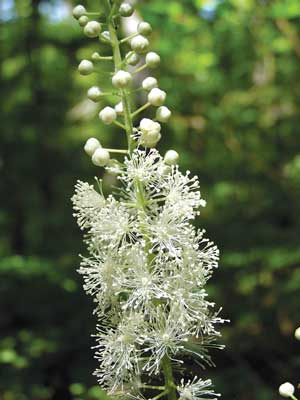
Black Cohosh (flower)
Black Cohosh (root and rhizomes)
1. History

  • originated in North America; gynecological disorder remedy by a Native Americans tribe (Algonquia). [2]
    • believed cohosh = pregnancy in Algonquians. [2]
  • first described in 1705 in botanist Leonard Plukenet [2]
  • many early settlers adopted; long tradition of use in the United States and Europe [2]


2. Medicinal and non-medicinal use
  • roots and rhizomes →  tx menopausal sx (hot flashes & sleep and mood disturbance) [4]
  • 19th century america home remedy → rheumatism and fever,as a diuretic that brings on menstruation [1]
    • colds, cough, constipation, hives, backaches, and induce lactation [1]
  • majority document reports on analgesic effects both men and women [2]
  • no protective effect on developing osteoporosis [4]

3) Active ingredient(s)
There are more than 50 secondary metabolites identified, in which the main proposed bioactive constituents are N-ω-methylserotonin which is a metabolite of serotonin [2], 23-epi-26-deoxyactein and cimicifugoside which are triterpene glycosides (steroid precursors) [2] [4] [8], and fukinolic acid [1]. Ultimately, it is unclear what the active ingredients really are in black cohosh [9].

4. Theorized mechanism of Action
  • fukinolic acid, compound identified, → estrogenic activity (in vitro)[1]**2,4,8
  • no conclusive studies on its effect on LH, FSH, or uterus functions. (no significant)[1]
  • possible agonist and competitive ligand to opioid receptors [2]
    • Positron electron tomography imaging of the brains → binding in the nucleus accumbens (the placebo effect area)
  • possible partial serotonin agonist and not phytoestrogen (plant-derived xenoestrogen) [7]

5) Clinical Issues The standard dose of black cohosh is two 20 mg tablets two times daily (Remifemin). It has been proposed that the 20 mg tablet two times daily may be equally effective. The standard dose for the tincture is 2 mL two times daily for a 1:1 tincture in 90% alcohol. However, the standard dosage may vary depending on the indication. The maximum effect usually occurs in four to eight weeks.  
Overdose symptoms are not well known, but may include nausea, dizziness, seizures, visual disturbances, reduced pulse rate, and increased perspiration [3] Adverse reactions include allergic reactions, which are rare [3], gastric complaints [1] [12], headaches [1] [12], dizziness [12], hypotension [12], osteoporosis [12], weight problems [1], possible uterine and breast tissue effects with long-term use [1], and hepatotoxicity. While several case studies exist in regards to hepatotoxicity, there is insufficient data to determine a conclusive correlation [1] [2]. The USP however, does suggest including a cautionary statement on the label of black cohosh products: "Discontinue use and consult a healthcare practitioner if you have a liver disorder or develop symptoms of liver trouble, such as abdominal pain, dark urine, or jaundice."
In regards to pregnancy use, the general consensus is to avoid use due to the potential ability to stimulate uterine contraction [3] and potential adverse outcomes to neonates [1]. However, black cohosh use in pregnancy has not been rigorously studied [1]. In regards to lactation, the degree of transmission is unknown. Breast cancer is another controversial area remains; some sources suggest black cohosh as a potential treatment and other suggest that the cancer is exacerbated [3]
Drug-drug interactions are also not rigorously studied. Possible interactions include anti-estrogens, estrogens, HRT, birth control pills, BP agents, and agents that increase bleeding risk. Examples include cyclosporine, azathioprine, warfarin, and tamoxifen

6. Efficacy vs Safety
  • caution with women with personal or strong family history of breast cancer [4]
  • case reports of hepatotoxicity [1]
  • studies down in mostly in Germany of 2,000 women show black cohosh has same efficacy as estrogen-containing product for treating menopausal symptoms[4]
    • open trial, lack blinding, and long term follow-up

7) Information about the standard of the various preparations available 
Extracts are standardized to 27-deoxyactein [1], in which the dosage is based on its content of triterpenes [12]. Commercially available preparations usually contain 1 mg of total 27-deoxyactein in each 20 mg dose (Remifemin) [1] [3]. Black cohosh is also available as liquids and teas [3].

8. Cost (compare to prescription medicine)
  • inexpensive (<$25) [3] price from $12 to $15 (quantity or dose)
  • menopausal medication [5] [6]
    • oral, hormonal (estradiol replacement) many generics available, <$15 per month
    • transdermal unit price > oral unit price
    • non-hormonal (SSRI, MAOI, Gabapentin, alpha adrenergic agonist) most expensive

9) Prevalence of use
In the late 20th century, black cohosh gained popularity as a remedy for the hot flashes associated with menopause [2]. This was escalated by women abandoning HRT to look for safe and effective non-hormonal solutions for menopausal symptoms [10] However, the natural stands of black cohosh are threatened [2] by habitat destruction, by excessive wild harvest that is greater than the plant's natural replacement rate, and an increasing global demand. Currently, wild-harvested plant materials supply nearly all commercial sales of black cohosh, placing a strain on the natural source of the plant.

10) Evidence-based medicine 
Studies have been done to determine black cohosh's effects on menopausal symptoms. Most studies assessed symptoms using the Kupperman index, a scale that combines measures of hot flashes, insomnia, and depression [1].Two randomized, double-blind, placebo-controlled trials have been performed to study the efficacy of black cohosh [1]. The results, however, are conflicting due to a lack of rigorous study design, short study duration, and difficulties in interpretation (e.g. different amounts of black cohosh from different sources used, different measurement outcomes) [1] [4]

11. Comparable prescription of non prescription medicines
  • inconclusive information on its efficacy against hormonal and nonhormonal therapy for menopausal symptoms. [7]

12) View of a pharmacist
Kenneth Newman, BS Pharmacy , “I have attended a women’s health seminar recently in which they recommended using black cohosh for night sweats and other menopausal symptoms. I think its a safe place to start for some women that are having difficulty managing the symptoms but a situation has not yet arrived where someone came in to specifically look for this product. I would feel comfortable talking to someone about this, I do not know if i would be able to answer all their questions but I am certainly willing to look them up”

Nhi Pham, PharmD, “From my own look at the available literature, black cohosh would never be something I would recommend; Soy products are known to be more effective and would be the alternative that I would suggest.”

References:

Vitamin Shoppe Interview


I visited the Vitamin Shoppe in Ann Arbor and asked about Group Awesome's three herbals : black cohosh, Glucosamine, and Milk Thistle. I asked my questions from the perspective of a pharmacy student and not a customer. I asked four main questions to the manager. 

What do you know about the products?

Every employee are very knowledge about the three products in terms of general usage and alternative products that do similar actions. If they did not know the exact mechanism, they had a reference book on the counter for customers. The manager stressed the fact that they are not prescribing any of the herbals. They do understand there are limitations to the clinical research behind these products and encourage their customers to talk with their doctor and/or pharmacist about the herbals. 

How did you deal with potential interactions with other herbal products? with prescription medications?

The manager showed me an extensive database that was accessible at the store-level and from their website. The database was very user-friendly where customers can simply type in their medication and it would give a list of herbals that would interact with it. Below is a screenshot for a customer on warfarin. (You have to click on Safety Checker that takes you to the page with a list of medications)  


How knowledge are the customers when they come into the store?

The regular customers knew what they wanted when they came into the store. However, the new customers usually would have an idea what they want to treat but do not know what is the best product to pick. The manager stressed the point that a lot of customers would rather take a herbal over prescription medications based on the perception they are 'safer'. 

How are the employees educated with the products?

All employees are required to attend Vitamin Shoppe University, a series of online courses and/or modules where they learn almost all the products indications. Not all products are taught. The manager did not give the time frame employees need to be enrolled for prior to working on the floor.

Overall, they were very receptive to a pharmacy student asking information about the function of the store. They gave a lot of information. But I also got the impression there was a strong emphasis that they work with healthcare workers and strongly stress they do not do any prescribing, as if they are "playing their part". There were a lot of traffic the time I went in, so I could not observe how the employees gave out advises.